Why Retail Media Deals Fall Apart — and What to Do About It
Jaiah Kamara, Founder — Signal to Summit
Why Deals Fall Apart in Retail Media
You might have a killer product that retailers should buy. You nail the demo. The retail media lead loves it. You’re close to completing your SOW — and the deal falls apart.
Most people think the deal dies because of missing features or budget constraints. But after 15 years in retail — seven of those years building measurement infrastructure at a top-10 retail media network — here’s what I’ve actually seen:
Deals don’t fall apart because of your product. They fall apart because platform providers consistently misread what’s actually happening inside these organizations.
What Platform Providers Consistently Underestimate
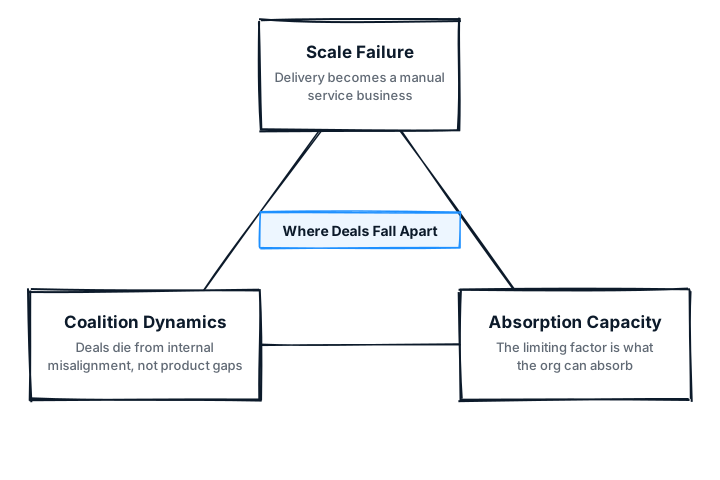
I’ve watched deals fall apart — not because of missing features, but because the platform provider misread the operating reality inside the retail media network. These are the three most common misreads. If you’re selling into retail media, these are the patterns that kill your deals late in the cycle.
Misread #1: “Once Implemented, Scale Will Follow”
Reality: scale fails because delivery becomes a manual service business.
Implementation goes live. The platform is connected. Capability is delivered. But the organization is still running the same way it always did — same intake chaos, same approval chains, same data inconsistencies, same retail prioritization cycles that interrupt everything. The platform becomes another underutilized tool — not the way work actually gets done.
Retail media doesn’t break on strategy. It breaks on delivery. Every campaign becomes bespoke. New inputs, new rules, new approvals every time. Operations becomes a ticket factory — trafficking, QA, troubleshooting, escalations. Reporting becomes hand-built — spreadsheets, one-off logic, constant reconciliation. The result: revenue grows linearly with headcount. That’s your scale ceiling.
This is the critical point platform leaders must internalize: if your platform doesn’t relieve a measurable constraint that’s currently capping scale, hindering performance, or blocking proof, adoption will plateau. Retail media teams don’t have spare capacity to “add another system.”
The real question isn’t “does it have features?” The real question is: what constraint gets measurably better in the first 30 to 90 days — and how will we prove it together?
Is it time and throughput — cycle time, turnaround, SLA performance? Is it proof and incrementality — better lift measurement, identity resolution, clean room capability? Is it standardization and repeatability — less bespoke work, fewer exceptions, consistent outputs? Is it speed to revenue — faster packaging, faster booking, shorter time-to-first-dollar?
If you can’t point to one of these and show measurable improvement fast, you’re asking a team that’s already underwater to learn another tool. And they won’t.
The real question isn't "does it have features?" The real question is: what constraint gets measurably better in the first 30 to 90 days?
Misread #2: “The Retail Media Lead Is Aligned — This Deal Will Move”
Reality: retail media leaders don’t buy alone. They operate inside a coalition with veto power.
Your champion — the retail media leader — loves your platform. The demo went great. They see the value. You’re building the SOW. But then merchants say, “We can’t disrupt the status quo.” Product says, “We don’t have roadmap capacity.” IT says, “We should just build this ourselves.” Legal redlines the contract until you don’t recognize it. Finance asks, “Show me the ROI again.” Procurement says, “We can’t finalize terms for six weeks.”
Even with strong initial intent, the deal is under scrutiny. Momentum dies. The retail media leader didn’t change their mind. The coalition did.
If you’re selling to retail media, you have to sell to the coalition — not just the champion. Map the stakeholders. Address their individual needs. Build the case in language that works for merchants, for IT, for finance, for legal. Not just a product demo — an alignment strategy.
The real gating challenge isn’t product capability. It’s internal alignment. And if you don’t design for that, you get trapped in “we’ll revisit this next quarter.” Forever.
The real gating challenge isn't product capability. It's internal alignment.
Misread #3: “If They’re Not Moving Fast, It’s a Priority Problem”
Reality: retail media leaders operate under capacity, risk, and calendar constraints that outsiders consistently underestimate.
When they say “not now,” that often means they’re in a peak cycle or a frozen change window — not lack of interest. When they say “we’re stuck,” that often means risk — legal risk, privacy risk, brand risk, shopper experience risk — not indecision. When you get silence, that often means meeting overload and constant triage — not disengagement.
Platform leaders misdiagnose capacity and risk constraints as lack of belief. They push harder when they should be redesigning for absorption.
Retail media is built inside a business that cannot slow down. Change competes with retail calendar realities, governance and risk controls, and constant cross-functional escalation traffic. The limiting factor is often absorption capacity, not strategic interest.
If your platform requires constant attention, re-education, or exception handling to generate value, it will become friction. Winning platforms minimize decision load and change load so that progress can happen even when the organization is at capacity.
Deals don’t fall apart because of missing features. They fall apart because platform providers underestimate the delivery friction, the coalition dynamics, and the capacity constraints inside retail media organizations.
Some retail media networks are figuring this out. But first, you need to understand the reality these leaders are navigating every day — because it’s more intense than most platform providers realize.
The Retail Media Reality Platform Providers Underestimate
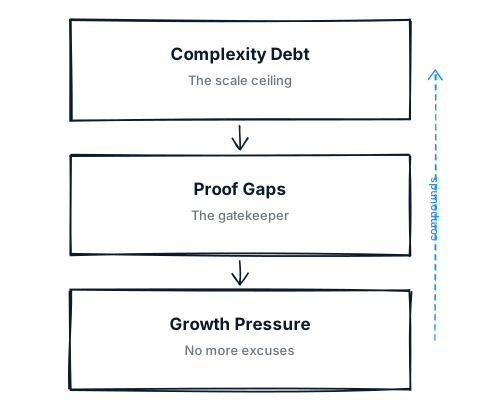
Retail media leaders wake up every day facing three simultaneous pressures.
Complexity Debt: The Scale Ceiling
Retail media can’t scale efficiently inside legacy retail. This isn’t minor friction — it’s structural complexity that caps growth no matter how much demand you have.
First, there’s fragmentation. Merchants, media teams, IT, finance, marketing, legal — they all pull in different directions. There’s no single owner of the end-to-end operating system. Retail priorities consistently override media needs. Every time.
Then there’s the manual work problem. Campaign setup, approvals, reporting, billing, proof — it’s all labor-intensive. Complexity grows faster than revenue. Teams run on heroics instead of systems. You can’t hire fast enough to keep up.
The talent gap makes it worse. Media operations, ad tech, data engineering, measurement science — these skills aren’t native to traditional retail. They’re hard to hire into legacy structures. Scale depends on individuals, not repeatability.
The result: revenue grows linearly with headcount. That’s your ceiling. The existing retail operating model cannot deliver media-scale execution.
Proof Is the Gatekeeper
Growth only matters if it can be credibly proven — both externally and internally. You’re being judged in two courts simultaneously.
Externally, advertisers and agencies are insisting retail media prove its value. More of them are demanding incrementality measurement because they have little faith when retailers grade their own homework. Self-attributed ROAS is rightfully being challenged. Advertisers want lift studies. They want comparable methodology across networks. Directional reporting doesn’t pass scrutiny anymore — not when they’re consolidating millions of dollars.
Retail media is entering its accountability era. As budgets consolidate and scrutiny intensifies, retail media networks are being asked to prove their value the same way the rest of digital media does. If retail media’s measurement can’t defend itself in a holding company QBR, that budget moves to a network that can.
Retail media is entering its accountability era.
Internally, it’s just as brutal. CFOs and boards are asking: is retail media expanding the pie, or are we just renaming trade dollars as media revenue? Once the upfront tech investment is made, retail media can deliver profit margins north of 50% for retailers — so finance has every incentive to scrutinize whether those margins are real or just reclassified. Is this improving profit quality, or are we cannibalizing merchant economics?
If retail media looks like reclassified trade, internal trust collapses. Finance pulls support. Merchants start fighting for attribution credit.
Most networks face a common problem: their measurement systems aren’t built for decisions. Reporting explains what happened. It doesn’t tell you what to do next. Definitions vary by team. Finance and advertisers don’t share a common truth. Without decision-grade proof, growth is fragile. Advertiser investments shift away. Internal support erodes. QBRs turn into debates instead of strategic planning.
Growth Pressure: No More Excuses
Retail media is on the scoreboard now. Five years ago, it was a pilot — an experiment. Today, boards and CEOs have made commitments: growth targets with timelines attached. Retail media leaders aren’t managing innovation projects anymore — they’re accountable for material revenue contribution. Platform providers are no longer selling into experimental budgets — you’re competing for production dollars where ROI scrutiny is brutal.
This is happening during an arms race for advertiser dollars. Large brands are consolidating their retail media investments — choosing their top three or four networks and concentrating budget for maximum impact. Holding companies are following suit, consolidating spend across their entire client roster. Amazon and Walmart account for roughly 88% of U.S. retail media revenue — and they’re projected to capture about 89% of incremental growth in the near term. If you’re not perceived as a winner, you lose access to talent, partnerships, and budget renewals.
The tension: those growth expectations were set higher than execution reality allowed. TAM stories moved faster than operating readiness. With spend consolidating and scrutiny rising, the goalposts are moving. Growth narratives aren’t enough anymore — proof is. Hit aggressive targets quickly, or retail media loses credibility before it’s fully built.
That’s the reality: complexity debt is blocking scale, proof is the gatekeeper determining whether any of this lasts, and growth targets are real with no room for excuses.
The networks that win aren’t just fighting through these pressures — they’re building something different.
How Winning Organizations Close the Gap
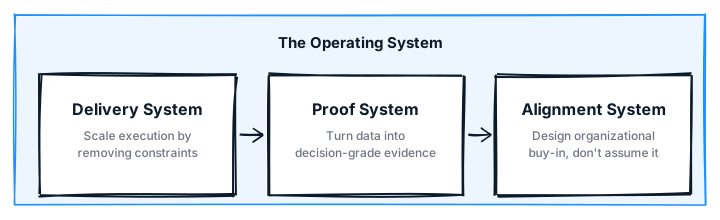
Retail media doesn’t fail because of lack of ambition or technology. It fails because no one designs the operating system that connects growth ambition, execution reality, and decision-grade proof. The networks that win build that system intentionally. It has three layers.
Scale Requires a Delivery System
Retail media organizations invest in platforms, but execution remains manual, bespoke, and fragile. Scale breaks when delivery becomes a service business.
Each campaign introduces new inputs, new rules, new exceptions. Operations teams become ticket managers. Reporting relies on heroics.
Winning organizations focus on constraints, not features. They identify the binding constraint limiting scale right now. They redesign workflows so that work is removed or dramatically simplified. Capability is only introduced when it changes how work actually happens — not when it adds another dashboard.
When delivery is systemized: throughput improves without proportional headcount growth. Execution becomes repeatable instead of bespoke. Teams regain capacity to focus on strategic priorities instead of firefighting. Scale comes from removing constraints, not adding tools.
Durability Requires a Proof System
Even when retail media improves performance, growth remains fragile without proof that holds up internally and externally. You’re still being judged in two courts simultaneously. Advertisers and agencies demand credible, comparable performance. Finance, merchants, and boards demand net-new value and profit quality.
When proof isn’t aligned between those two courts, every quarterly business review becomes a debate. Every budget cycle resets to zero.
Winning organizations operationalize proof. They define what “counts” before measurement begins. They standardize metrics, definitions, and narratives so everyone is working from the same truth. They run learning agendas and incrementality programs as repeatable systems, not one-off science projects.
When proof is decision-grade: QBRs drive decisions instead of arguments. Budget confidence increases. Growth compounds instead of resetting every cycle. Growth lasts when proof supports decisions, not just reports results.
Growth Requires an Alignment System
Retail media leaders are accountable for aggressive growth, but alignment across the organization is assumed instead of designed. Growth targets get set at the board level. Execution requires buy-in from merchants, finance, IT, legal, product, sales. When alignment isn’t made explicit, progress stalls late — and quietly.
Winning organizations design alignment up front. Decision rights are clear: who must agree, who must be consulted, who owns outcomes. Success is defined in language each stakeholder can support — not just “grow revenue 40%” but what that means for merchant margin, for brand perception, for IT capacity, for finance reporting. Risk is surfaced early, not discovered mid-flight.
When alignment is treated as a system instead of an assumption: fewer late-stage stalls, faster decision velocity, and growth plans that survive contact with the organization. Growth scales when alignment is designed, not assumed.
Winning retail media organizations don’t succeed by doing more. They succeed by building an operating system — one that scales execution by removing constraints, turns data into decision-grade proof, and aligns growth ambition to organizational reality. This is the difference between temporary momentum and durable growth.
The Insight You Can’t Afford to Miss
A lot of leaders entered retail media with big expectations. The winners are the ones who built the operating system to deliver. Retail media looks simple from the outside — sell ads, show ROAS. But in reality, you’re building a digital publishing and measurement business inside a legacy retailer. That’s a different sport.
You’re building a media company inside a retail company. And the default retail operating system — processes, priorities, tech, decision rights — was never designed for speed, experimentation, or advertiser-grade measurement.
This isn't a channel problem. It's an operating model problem.
Why I Do This Work
I’m Jaiah Kamara, founder of Signal to Summit.
I spent 15 years in retail — seven of those years in central leadership roles building the reporting and measurement infrastructure at a top-10 retail media network. I built systems that drove advertiser confidence: reliable reporting infrastructure, decision frameworks that empowered action, operating models that ensured data quality, and cross-functional ways of working that aligned sales, strategy, and measurement around shared truth.
I spent seven years watching platform providers lose deals they should have won — because they missed the signals I could see from inside. I now help them read those signals early.
The Signal to Summit Difference
Most of my work in retail media wasn’t about strategy decks. It was about building systems that drove advertiser confidence and organizational readiness. Retail media leaders are trying to grow inside systems that weren’t designed for media. Platform leaders are building powerful tools without fully accounting for how retail actually operates. I guide from the middle — translating platform capability into adoption and scale inside the retailer.
If you’re a technology or service provider trying to understand why deals stall — the signals are there. I help you read them early.
Keep Reading

June 1, 2026
Ecosystem Unification: The Third Dimension of Measurement Maturity
Defined by whether your measurement holds together across the whole portfolio, or only works one channel at a time.
April 28, 2026
Operational Delivery: The Second Dimension of Measurement Maturity
Defined by whether your proof gets there in time to matter.

April 21, 2026
Proof Capacity: The First Dimension of Measurement Maturity
Defined by what your measurement can demonstrate, and to whom.